
Strong looks like this
"I’ve asked legal to pre-review the MSA." That action would satisfy a skeptic.
Loading
Step 04 of 6 · Validate · Buyer Readiness Index
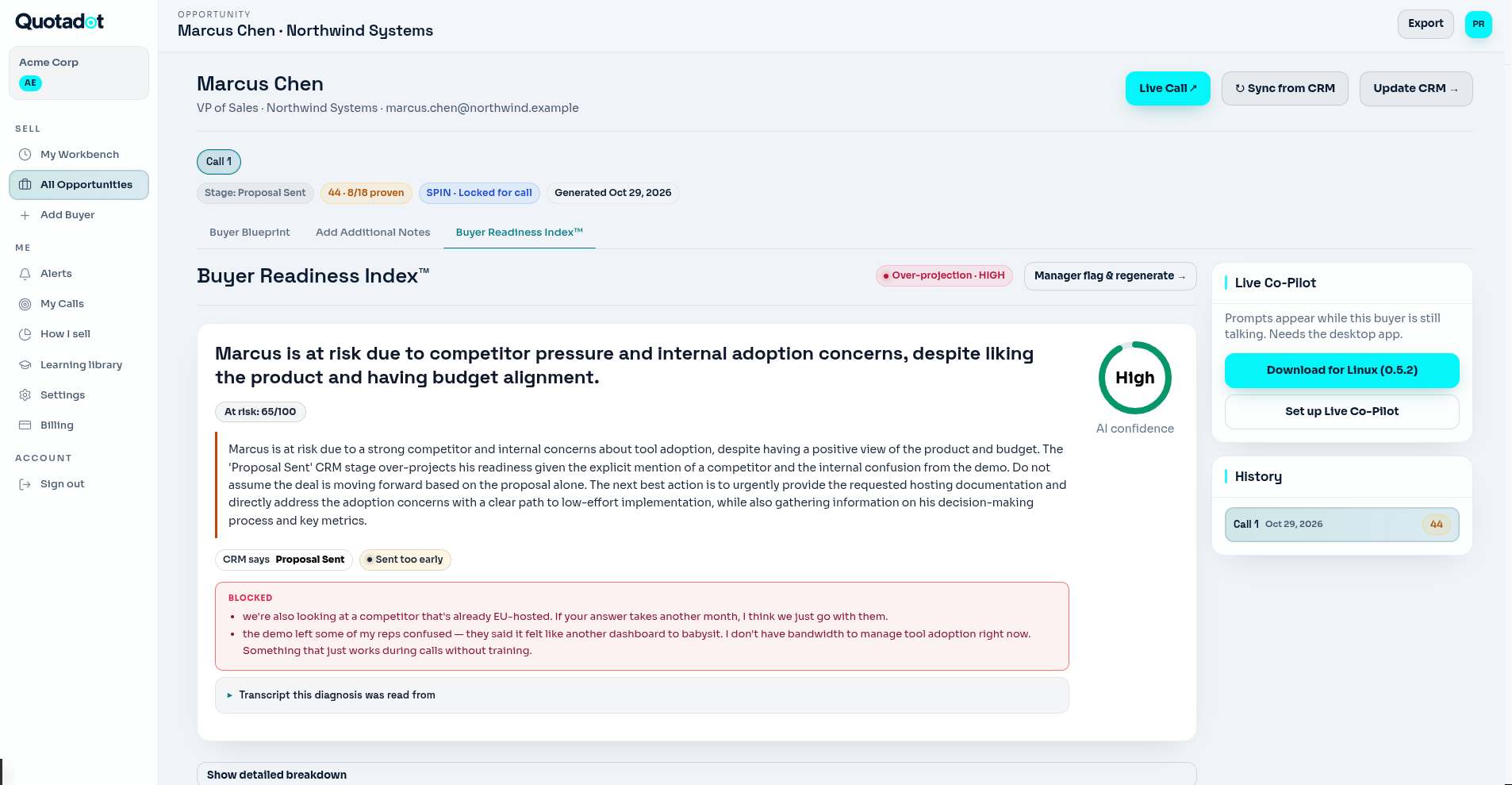
The Buyer Readiness Index is a post-call score of how ready a buyer is to move in a live sales call, not sales-rep readiness or mortgage pre-qualification. It rates five dimensions, Pain Recognition, Trust Formation, Problem Urgency, Solution Confidence and Commitment Behavior, each marked strong or weak from a verbatim quote, or unproven when the call gave none.
It runs after the call ends, scoring what Live Buyer-State Intelligence watched during it. Stage–Readiness Alignment, next, compares that score against where the deal sits in the CRM.
The index, annotated
Each dimension carries the quote that earned its mark.
Sample data · Buyer Readiness Index · Daniel Mercer · Vanishlink
after today’s call
In practice
Readiness scores what this buyer did and said about this decision, and it makes no personality judgments.
"I’ve asked legal to pre-review the MSA." That action would satisfy a skeptic.
"This looks great." A compliment carries no evidence, so it does not score.
The dimension records the gap instead of guessing.
How it comes together
what was said and done
actions from the call
strong, weak or unproven, each with evidence
where this decision stands
Trust
STRONG FROM THE ACCOUNT
Champion brings the CFO unprompted.
Five dimensions from the call, Pain Recognition, Trust Formation, Problem Urgency, Solution Confidence and Commitment Behavior, each marked strong, weak or unproven.
An action a skeptic would accept, such as asking legal to pre-review the MSA, where a compliment like "this looks great" counts for nothing. Every dimension marked strong or weak carries a verbatim quote from the transcript, and a quote that is not word for word from the call, or that another dimension already uses, is not accepted.
No. It scores what the buyer did and said on the call and never rates the buyer as a person. Readiness is based on what the buyer has done and what a skeptic would accept as evidence.
After every call, using evidence from that call.
Pain Recognition asks whether the buyer names the problem in their own words. Trust Formation asks whether the buyer shows you the real problem. Problem Urgency asks whether the problem needs action now. Solution Confidence asks whether the buyer believes the solution can produce the outcome they want. Commitment Behavior asks whether the buyer takes the next step the deal needs.
No. The score is not an average of the five dimension marks. It reflects how far the buyer has moved toward a decision, so a buyer who has named the problem and its cost can score well past the early states while urgency and commitment are still weak.
The dimension gets no mark it cannot quote. A short call or one without real signal leaves the dimensions it cannot back with the buyer’s words unscored or marked unproven, and never fills them with a repeated or invented quote.
In the sample deal, the buyer says "Honestly the ramp thing is fair. I'm on more calls than I was a year ago, not fewer." Pain Recognition scores strong on that quote. He also says "It's not on fire. It's just the thing I keep meaning to fix." Problem Urgency stays unproven, and the call lands in the stakeholder validation needed state with the unsigned stakeholder as the primary blocker.
Quotadot reports readiness as one of eight states after each call: Unaware, Problem-aware, Diagnosis-aligned, Solution-curious, Solution-confident, Needs stakeholder validation, Commercially ready and Commit-ready, with a separate At risk flag. A state is earned only from what the buyer demonstrated on the call, and Stage–Readiness Alignment then compares it with the CRM stage.
Stage–Readiness Alignment, the next step in the loopYes. After each call Quotadot turns the transcript into a readiness score from 0 to 100, one of eight states with a separate at-risk flag, five dimensions backed by verbatim quotes, and two blockers with the evidence and the next action. The Manager Coaching Report shows the manager how each rep used the live coaching on those calls.
The Manager Coaching ReportSee it on a sample deal
The score lands after every call, from that call’s own transcript.
Keep exploring
Step 01 · Understand
A sourced brief on one buyer, short enough to read in the ninety seconds before the call.
Learn more about Pre-Call Buyer IntelligenceStep 02 · Prepare
A plan for how this call opens: your script, rewritten in the technique that fits this buyer.
Learn more about Buyer's BlueprintStep 03 · Observe
A quiet cue with the signal behind it, shown only when the call gives the coach something worth saying.
Learn more about Live Buyer-State IntelligenceStep 04 · Validate
Five readiness dimensions scored after the call, each backed by something the buyer said or did.
You are here
Step 05 · Adjust
Where a deal sits in your CRM, set against what the buyer has proved.
Learn more about Stage–Readiness AlignmentStep 06 · Learn
Each rep’s last 10 coached calls reduced to one band, worst first.
Learn more about Manager Coaching Report