
Needs you
The rep acts on few of the suggestions shown on screen, and the share is not improving.
Loading
How it works
Quotadot is an AI sales copilot with an Intelligence Loop. No bot joins your call. It runs as a transparent overlay on your own desktop, over Zoom, Teams, Meet or any call that plays through your computer.
Six steps wrap each conversation. Understand and prepare come before it starts, observe runs while it happens, and validate, adjust and learn follow once it ends.
The Intelligence Loop
Learn does not end the cycle. What the post-call readiness read proved, left open or got wrong goes into the next Buyer's Blueprint, which sets the objective of the next conversation and briefs the live coach before it starts, so each call opens on what the deal still has to learn.
See the Intelligence Loop →Powered by Live Buyer-State Intelligence. Quotadot follows the live conversation as text and reads what the buyer says and how the turns go, not the tone of voice. When it detects a buyer signal or objection that matters, it gives the seller two things within seconds. It names the next best move and offers up to two questions the seller can ask.
SIGNAL
Buyer says rollout staffing is limited.
NEXT MOVE
Name the capacity concern out loud before moving on.
TO ASK
"Who owns the rollout on your side?" or "What would a phased start look like?"
Possible next best moves
Nothing meaningful happening? Quotadot stays quiet. It speaks when the buyer's signal changes, when a call milestone is still missing or when the rep slips, so a cue on screen means the conversation gave the rep something to act on. That is what makes it feel less like software throwing prompts at you and more like an experienced coach beside you on the call.
See one cue, line by line →Live discovery
When the team’s framework is MEDDPICC, which is the default, the overlay fills in its eight letters live. They are Metrics, Economic buyer, Decision criteria, Decision process, Paper process, Identify pain, Champion and Competition.
During the call
The overlay fills in each MEDDPICC letter live, so the rep sees what discovery has covered while the buyer is still on the line.
After the call
A MEDDPICC card on the deal marks each letter proved on the call, partly proved or not proved yet.
Human-first belief
Buyers don't want to be automated at. They want to be understood by someone who did the work. Quotadot gives that person better eyes and leaves the conversation in their hands.
The AI observes. The human decides. That order never inverts.
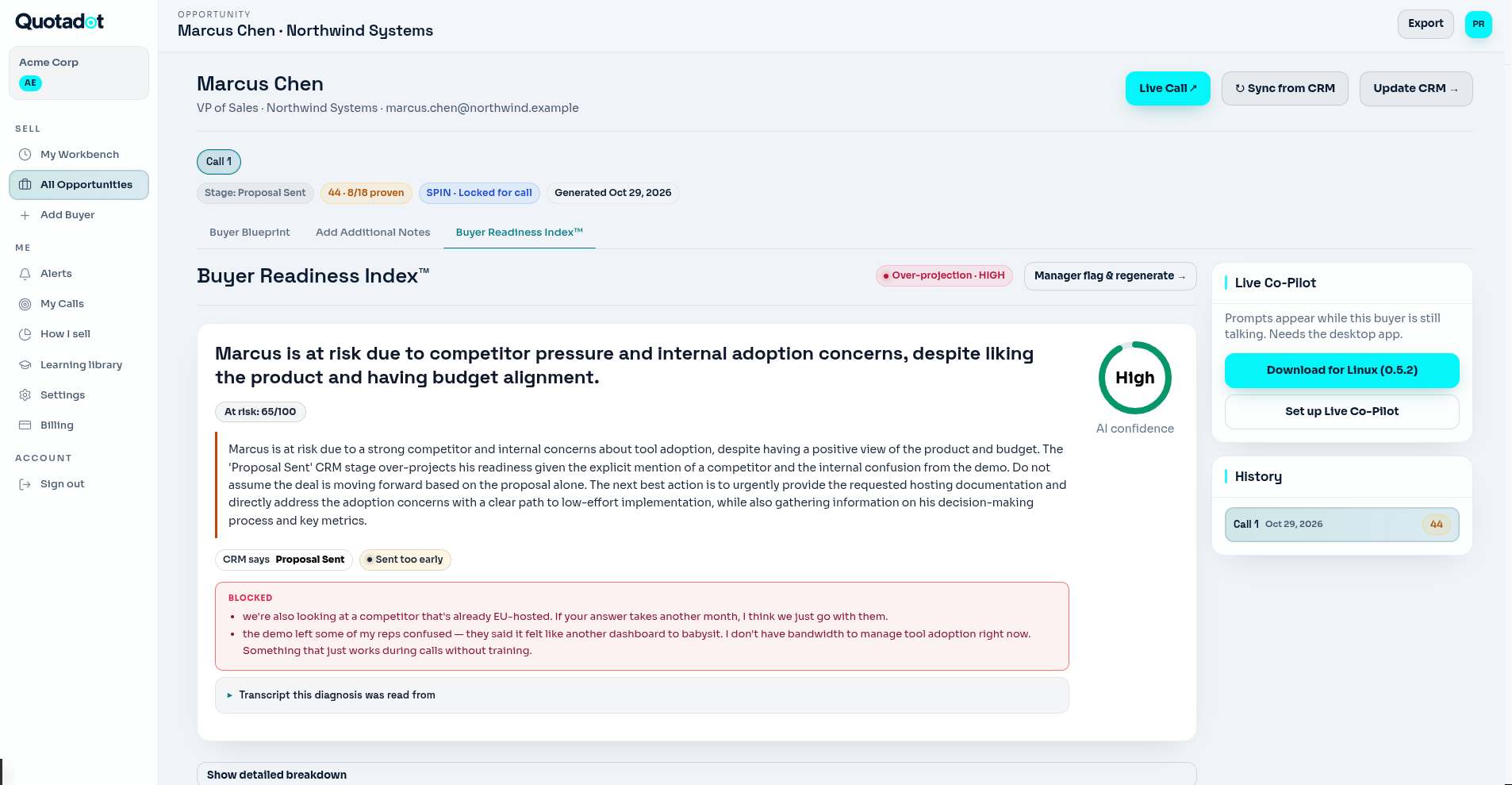
Five dimensions, each backed by something the buyer said or did, never by how the call felt.
Weak signal
"This looks great."
Stronger evidence
"I've asked legal to pre-review the MSA."
Weak signal
Champion attends every call.
Stronger evidence
Champion brings the CFO unprompted.
Weak signal
"Send me pricing."
Stronger evidence
"Here's the budget line we'd take it from."
What has this buyer actually done that a skeptic would accept? A dimension with no such words from the buyer is marked unproven.
See how the Buyer Readiness Index scores a call →03 Stage–readiness alignment →
CRM view
Buyer view
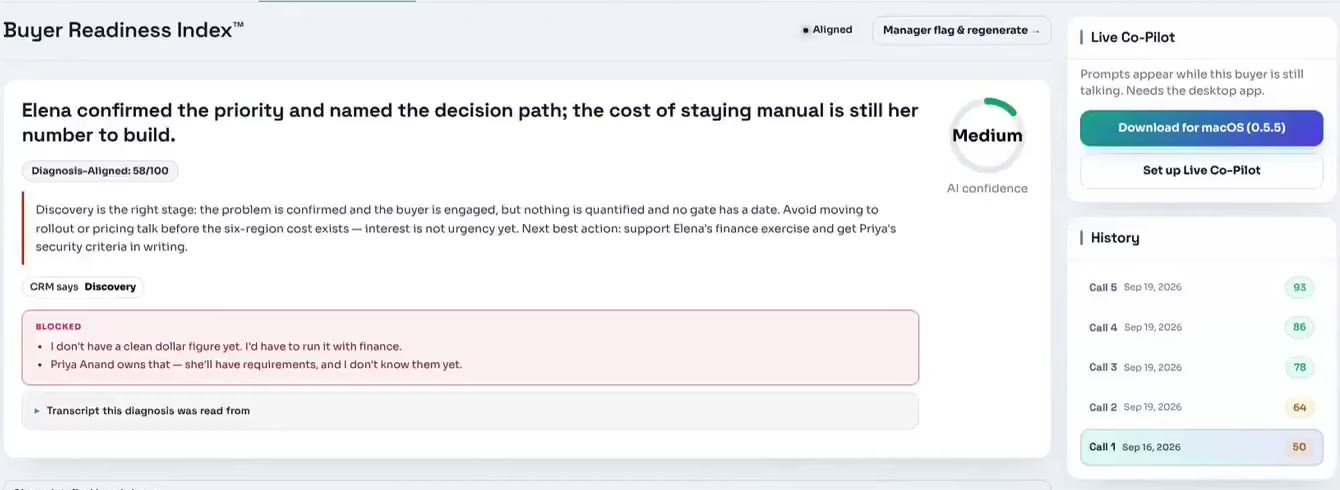
Quotadot compares where the deal sits in your process against what the buyer has demonstrated. It flags the gap while there is still time to close it.
Misalignment is not a reporting problem. It's next quarter's miss, arriving early. Where the CRM stage and the readiness score disagree, review that deal first in the next pipeline meeting.
See how Stage–Readiness Alignment compares the two →04 Revenue leadership value
Once a call has been diagnosed, the deal carries one of three statuses, so pipeline reviews start where the risk actually is.
ALIGNED
Stage and buyer evidence agree. Let the rep run.
UNDER-PROJECTED
The buyer is further along than the CRM stage says. Check whether the stage should move.
OVER-PROJECTED
The CRM stage is ahead of the buyer's evidence. Inspect before the pipeline review.
Which deals are moving because the buyer moved? Ask it in week three, not week twelve.
Each rep's band, the share of live suggestions they used over their last 10 coached calls, and whether it is rising or falling.
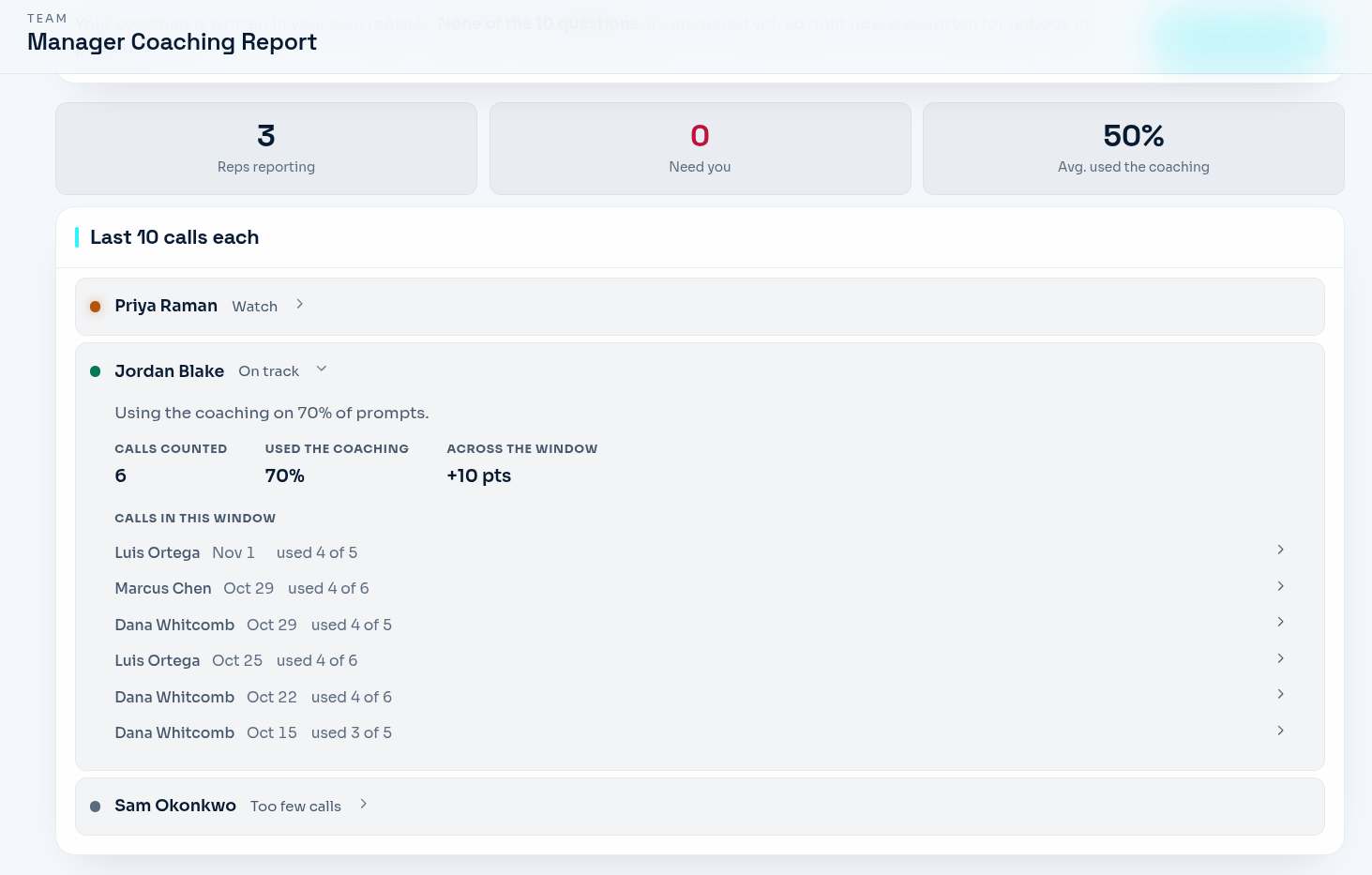
Reps are ranked worst first, so the one to sit down with is at the top.
On track, Watch or Needs you. A rep with fewer than three coached calls shows Too few calls.
The share of on-screen suggestions the rep acted on over the last 10 coached calls.
Whether that share is rising, flat or falling across those calls.
Each rep's recent coached calls, with the transcript to read before the 1:1.
Slips the live coach flags during the call
The report ranks reps worst first and links to the calls behind each band, ready before the 1:1.
See the Manager Coaching Report →06 Rep development
The Manager Coaching Report puts each rep in one of three bands, from their last 10 coached calls.
Needs you
The rep acts on few of the suggestions shown on screen, and the share is not improving.
Watch
The share used is below where it should be, holding flat or slipping.
On track
The rep is using the coaching and the share is holding, or it is still low but climbing.
What each rep gets after a call
Watch the trend as well as the band. A rep whose share is still low but climbing can be reported as On track.
07 The compounding intelligence system
The loop closes. What Tuesday's call proved shows up in Thursday's Blueprint for the same deal.
Every call adds quoted evidence to that deal's buyer record.
Each blueprint starts from a better hypothesis than the last.
Live cues track which signals and qualification items the buyer has already given.
Every readiness dimension cites the quote behind it, so a score can be checked against the call.
The manager report tracks how much of the live coaching each rep uses, call after call.
Deal confidence stops being a feeling: each deal has a readiness score with quotes behind it.
Before the next call, open the Buyer's Blueprint. It is rebuilt from what the buyer proved on the last one, and your CRM keeps the deal record with readiness evidence added when connected.
See how the Buyer's Blueprint is built →Book a pilot